Bodyweight Training 101: A Full Workout System With Zero Equipment
Bodyweight training has a branding problem. People hear 'no equipment' and assume 'not serious.' In reality, four honest bodyweight movements — push-ups, squats, plank, and burpees — can build strength, conditioning, and mobility that rivals most beginner-to-intermediate gym programs, with zero cost and zero commute.
These four movements aren't arbitrary. They're the same four exercises REPPED's roulette selects from during battles, because between them they cover pushing strength, lower-body strength, core stability, and full-body conditioning — the four pillars of general fitness.
Push-ups: upper-body pushing strength
Push-ups train chest, shoulders, and triceps while demanding real core stability to keep your body rigid. Progress by adding reps, slowing the tempo, or elevating your feet — not by sacrificing depth. A slow, full-range push-up is worth more than a fast, half-range one, on REPPED and in real life.
Squats: lower-body strength and mobility
Bodyweight squats build quad, glute, and hamstring strength while training ankle and hip mobility that a lot of adults quietly lose from sitting all day. Depth matters here too — breaking parallel (hips below knees) is what separates a real squat from a knee-bend.
Plank: core stability under fatigue
Planks don't look impressive, which is exactly why people skip them — and exactly why their form falls apart under fatigue in every other exercise. A strong plank means a straight line from shoulders to ankles held under a ticking clock, no sagging hips, no raised glutes.
Burpees: full-body conditioning
Burpees are the great equalizer. They combine a squat, a plank, a push-up, and a jump into one movement that spikes your heart rate faster than almost anything else you can do standing still in a bedroom. They're also the exercise most likely to expose a fake or half-hearted rep, which is why our scoring treats incomplete cycles as void.
A simple weekly structure
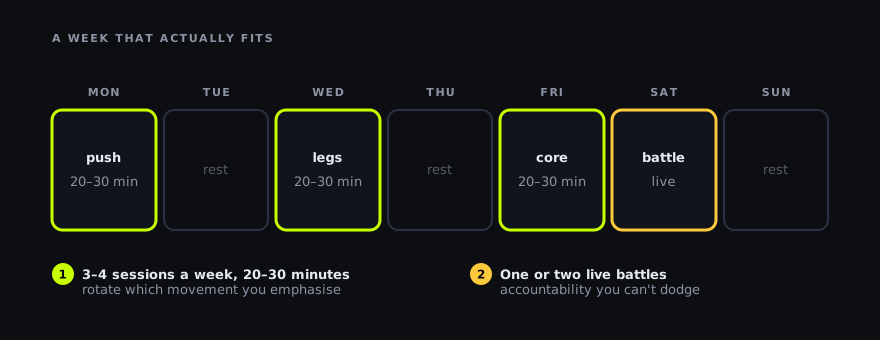
- 3–4 sessions per week, 20–30 minutes each
- Rotate which movement you emphasize each session
- Track reps-in-30-seconds as your baseline metric — it's honest, fast to measure, and improves quickly
- Add a live battle once or twice a week for accountability you can't talk yourself out of
How to progress without adding weight
The standard objection to bodyweight training is that you cannot add load, so you must eventually stop getting stronger. It is half right: you cannot add load easily, but load is only one of the ways a movement gets harder, and it is not the most useful one for most people.
Leverage is the first lever. Elevating your feet on a chair shifts a larger share of your bodyweight onto your arms, and elevating them further shifts more. The same push-up becomes progressively harder without a single gram of equipment entering the room.
Tempo is the second and the most underrated. A push-up lowered over four seconds, paused at the bottom, then pressed up, is a substantially harder exercise than the same push-up done in one second, because the muscle spends far longer under tension and gets no help from the bounce. Most people can make their current training meaningfully harder tonight without changing anything except how fast they move.
Range is the third. Hands on books to let the chest travel below them, or a squat to a genuinely low seat, extends the distance the muscle works over. And unilateral work is the fourth: a split squat asks one leg to do most of what two were doing, which is close to doubling the load with no equipment at all.
What bodyweight training will not give you
It is worth being straight about the gaps, because a guide that claims there are none is not worth trusting on anything else.
There is no pulling in this list. Push-ups, squats, planks and burpees are all pushing, legs and core, and nothing here trains the muscles that pull your arms toward you. Left alone for long enough that becomes a genuine imbalance, and the fix is any hanging or rowing movement — a bar, a sturdy table edge, a set of rings. This is the one gap worth actually solving.
Very heavy, low-repetition strength is also hard to reach without load. If your goal is a maximal single effort, bodyweight will take you further than the sceptics say and not as far as a barbell.
What it does cover is broad, honest general fitness, available in a bedroom, requiring nothing, at any hour. For the overwhelming majority of people the binding constraint on fitness is not the depth of the programme; it is whether it happens at all.
Reps in thirty seconds as a baseline
If you want one number to track, a fixed-window rep count is a better choice than almost anything else available to someone training at home. It takes half a minute, it needs nothing, and it responds to real changes within days.
It is also honest in a way a set to failure is not. A maximum set measures your strength and your willingness to suffer at the same time, and the second one varies wildly with mood. A fixed window puts a ceiling on how much the suffering can contribute, so what is left is mostly the thing you were trying to measure.
Take it under the same conditions each time — same exercise, same standard for what counts, ideally the same time of day — and write it down. Over a couple of months that column of numbers will tell you more about whether your training works than any amount of how you feel about it.
Why competition accelerates all of this
The hardest part of bodyweight training isn't the movements — it's showing up consistently when no one's watching. That's the entire premise behind REPPED: a 30-second camera-on battle against a real opponent turns 'I should work out' into 'I'm not losing to a stranger on the internet.' See how the matchmaking and scoring system works, or jump into the arena directly.