How Repped Works
Here's exactly what happens between opening REPPED and seeing your Elo move — no vague marketing, the actual mechanics.
Grant camera access
REPPED needs to see your full body to score reps accurately. Pose detection runs entirely in your browser — nothing is uploaded for scoring, and nothing is recorded. See exactly how in our AI Judging breakdown.
Get matched
Guests are matched against REPBOT, our AI opponent tuned to feel like a real fight. Signed-in players are matched against a live human opponent when one's available in the queue, or a friend via a direct challenge or duel link.
The roulette picks your exercise
One of four exercises is selected at random for both players: push-ups, squats, burpees, or plank. No re-rolls, no choosing your best event — that's the point.
30 seconds, camera on
A countdown starts and both players go live for exactly 30 seconds. The on-device model tracks your body at multiple frames per second, counting valid reps and flagging half-reps, poor depth, or missed lockouts as they happen.
The AI delivers a verdict
When time's up, your rep count, form quality, speed, and effort combine into a single 1–10 score. Whoever scores higher wins the match — see the full formula on our AI Judging page.
Elo updates, instantly
Signed-in players' ratings update immediately based on standard Elo math — beat someone rated well above you and you gain more than beating someone rated below you. Guest results stay local to your browser.
The four exercises
Every battle rotates through the same four bodyweight movements, scored on a consistent standard:
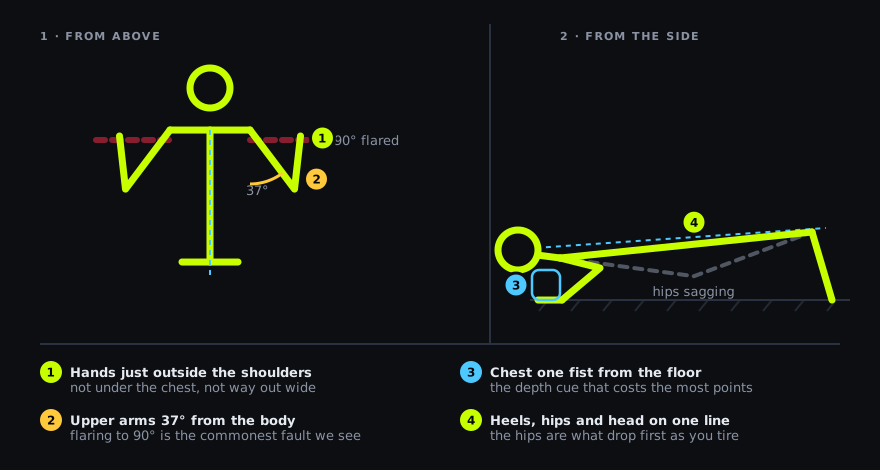
- 💥 Push-ups — ~20 clean reps in 30 seconds scores a perfect 10.
- 🦵 Squats — ~25 clean reps in 30 seconds scores a perfect 10.
- ☠️ Burpees — ~10 clean reps in 30 seconds scores a perfect 10.
- 🧱 Plank — held for the full 30 seconds; scored on stability, not reps.
Guests vs. accounts
You can battle instantly with no account — guest stats and Elo live only in your browser's localStorage and are never sent to our servers. Create an account and your Elo, match history, rank, and unlocked rewards save permanently and show up on the public leaderboard.
More ways to play
Beyond quick matchmaking, you can send a challenge link to beat a specific score, start a live duel with a friend via an invite link or QR code, or just watch live battles as a spectator with delayed data and MVP voting.
Want the mechanics behind each piece?
- How the AI judges every rep — the scoring model in detail
- How Elo rating works — why beating strong opponents matters more
- Fair Play and Anti-Cheat — how matches stay honest
- Seasonal Ranking — how monthly seasons and soft resets work
- Competitive Rules — the full ranked rulebook
What your first battle will feel like
Almost everyone paces their first attempt badly, and it is worth knowing in advance so you do not read the number as a verdict on your fitness. The opening ten seconds feel effortless, because they are running on energy already sitting in the muscle. Most people take that as permission to go faster, and then hit a wall somewhere around second eighteen that arrives much harder than expected.
The improvement between a first battle and a third is mostly pacing, not fitness. Pick a rhythm you could genuinely hold for the whole thirty seconds and start there. It will feel too slow. It will also produce more counted repetitions than sprinting and collapsing, every single time.
The other thing that surprises people is how much a rushed repetition costs. A fast shallow push-up is recorded as half a repetition, so it is worth half while costing you full energy. Two of them are worth less than one honest one done properly.
Setting the camera up once, properly
Nearly every complaint about repetitions not counting turns out to be a camera position problem rather than a scoring one. The model measures angles at your elbow, hip and knee, and it can only measure joints it can actually see.
Put the device on the floor or a low surface roughly two metres away, side-on, so your whole body from heel to head sits inside the frame. Side-on matters more than distance: facing the camera stacks your hip, knee and ankle along the line of sight, where their positions have to be guessed rather than seen. Thirty seconds spent getting this right once will save you arguing with the scoreboard for weeks.
Light helps too, and it does not need to be good light — it needs to be in front of you rather than behind you. A bright window at your back turns you into a silhouette, and a silhouette has no measurable joints.
If something goes wrong mid-battle
Connections drop, phones slip and people walk into rooms. The system is built to fail in your favour rather than against you: a battle that cannot be completed fairly does not get resolved against whoever had the worse luck.
If your opponent disappears you are not left staring at a frozen screen, and if you leave your own camera mid-round the repetitions simply stop being credited rather than being counted wrongly. A system that kept confidently counting a body it could not see would be worse than one that stops, because the numbers would be invented.