What Is an Elo Rating, and Why Fitness Apps Are Starting to Use It
Elo was created by physicist Arpad Elo in the 1960s to rank chess players fairly, and it's since spread to esports, online games, and now competitive fitness. Its core idea is simple: your rating should predict how likely you are to beat a given opponent, and every match result should nudge that prediction closer to reality.
The basic mechanics
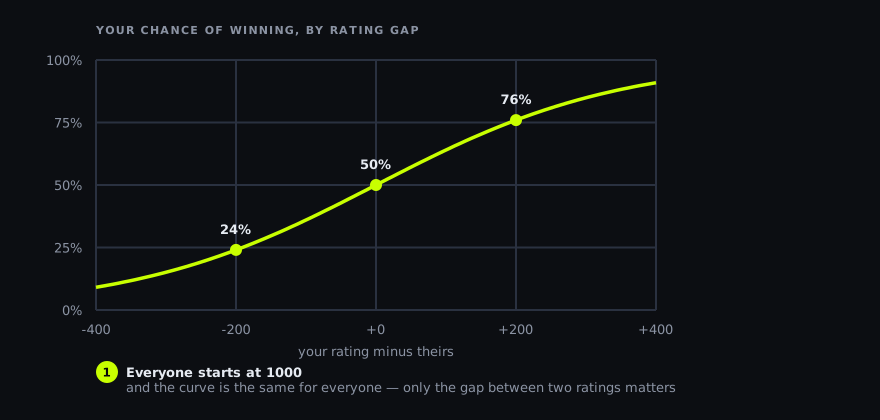
Every player starts at a baseline rating (1000 on REPPED). Before a match, the system calculates the expected outcome based on the rating gap between both players. If you beat someone rated far above you, you gain a lot of rating, because the system was 'surprised.' If you beat someone far below you, you gain very little, because that result was already expected.
Why this feels fairer than raw scores
A raw leaderboard sorted by total wins rewards volume over skill — someone who plays constantly against weak opponents can out-rank someone far stronger who plays rarely. Elo corrects for this automatically: beating strong opponents is worth more than beating weak ones, and the rating converges toward your true skill level regardless of how often you play.
Working through an actual example
Numbers make this concrete. Suppose you are rated 1,000 and you meet someone rated 1,200. The formula says you are expected to win about 24 per cent of the time. With a K-factor of 32, winning that match gains you roughly 24 points and losing costs you about 8.
Now reverse it. Rated 1,200, you meet the 1,000. Beating them gains you about 8 points; losing to them costs you about 24. The system is not rewarding or punishing anyone for who they are. It is simply paying out more for results it did not predict, in both directions.
The consequence people find counter-intuitive is that you cannot climb by farming easy opponents. Ten wins against someone 400 points below you are worth less than a single win against someone 200 points above. Ducking strong opponents does not protect your rating so much as freeze it.
What the K-factor is actually trading off
K is the only real dial in the system, and it sets how much any one result is allowed to move you. It is a straight trade between responsiveness and stability, and there is no setting that gives you both.
A high K means the rating tracks genuine improvement quickly, which matters in fitness where somebody can get meaningfully better in a fortnight in a way a chess player usually cannot. It also means one bad match — a phone that slipped, a bad night's sleep — visibly dents a rating that took weeks to build.
A low K makes the number stable and trustworthy, and makes it maddeningly slow to reflect the fact that you are now clearly stronger than you were last month. Thirty-two sits deliberately in the middle: quick enough that a real improvement shows up within a week of matches, damped enough that no single thirty seconds defines you.
Where Elo genuinely struggles
Elo assumes both players are trying, that the result reflects the thing being measured, and that skill changes slowly relative to how often you play. Fitness violates the third assumption more than chess does, which is the main reason it needs a livelier K.
It also has nothing to say about your first few matches. A brand-new rating of 1,000 is not a measurement, it is a guess, and it takes a genuine run of matches before the number means anything at all. Reading too much into your rating in week one is reading noise.
And it measures one specific thing: how you do in thirty seconds, at whatever the roulette picked, against the people you happened to meet. It is not a fitness score, it is not a health metric, and someone rated below you may well out-train you in every way that matters over an hour. It is the rating for this game, which is exactly as much as any rating should ever claim.
Why it fits fitness competition specifically
- Matches are short and frequent, which is exactly the condition Elo was designed to handle well
- Skill genuinely varies (fitness level, form, explosiveness), which Elo is built to measure over time
- It gives every match stakes, even between two low-rated beginners, because both ratings are on the line
- It naturally separates players into fair brackets over time — beginners face beginners, and elite reppers eventually only face other elite reppers
REPPED's version
REPPED uses standard Elo math with a K-factor of 32 — a moderate speed of rating change, fast enough to reflect real improvement quickly, slow enough that one lucky rep doesn't swing your rank wildly. Ratings are floored at zero so no one ever goes negative, and monthly seasons apply a soft reset that pulls everyone partway back toward 1000 without wiping progress. See the full breakdown on our Elo rating page, or check where your rating currently ranks on the leaderboard.