What Counts as a Squat: The Three Numbers Behind Every Rep
Every squat you do on REPPED is judged by one measurement: the angle at your knee, taken from the hip, the knee and the ankle, several times a second. Not depth in centimetres. Not how low you feel like you went. One angle, and three thresholds that decide what happens to it.
We are going to give you the actual numbers, because a scoring system you cannot inspect is one you have to take on faith — and because knowing them makes them easier to hit.
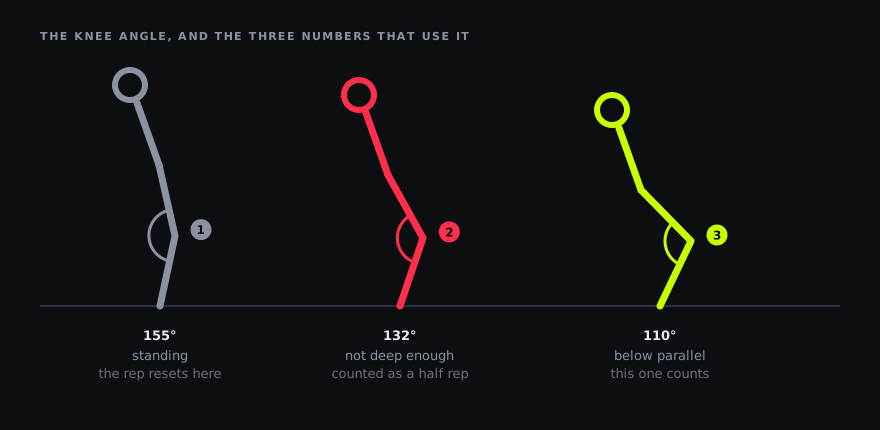
155 degrees: standing
Above 155 degrees your leg counts as extended and the rep resets. This is what stops the most common way of accidentally cheating a set: bouncing between half-depth positions without ever standing up. If you never cross back above 155, you never start a new rep, no matter how many times you go down.
It is 155 rather than 180 on purpose. Almost nobody locks a squat out to a perfectly straight leg, and demanding it would punish people with ordinary knee anatomy for something that has nothing to do with effort.
110 degrees: below parallel
Drop below 110 degrees and the rep is credited. This is roughly where the hip crease passes the top of the knee — what lifters call breaking parallel. It is the point where the movement stops being a knee bend and starts loading the hips and glutes the way a squat is supposed to.
Everyone's exact hip-to-knee geometry differs slightly, which is why the threshold is an angle rather than a height off the floor. A tall person and a short person hitting 110 degrees have done the same movement. A tall person and a short person both dropping 40 centimetres have not.
132 degrees: the one that catches people out
Between 132 and 110 you are in the dead zone. You have clearly squatted — the angle moved a long way — but you did not break parallel, and the rep is recorded as a half rep rather than a full one.
This band exists because the honest alternative is worse. Without it, a rep at 133 degrees and a rep at 156 degrees would both count as nothing, which feels arbitrary to anyone who was visibly working. With it, the system can say the specific true thing: you squatted, and it was not deep enough.
Why the angle is smoothed before it is used
Raw pose estimation is noisy. A single frame where your knee is momentarily occluded, or where the model guesses badly, can swing the measured angle by ten degrees. If the thresholds were applied to raw frames, you would get phantom reps whenever the camera flickered.
So the angle is smoothed across frames before it is compared to anything, and the reading is taken from both legs rather than one. It costs a few tens of milliseconds of responsiveness and it removes almost all of the false counting. That trade is worth making every time.
Why not just measure how far you went down
The obvious alternative is to measure displacement — how many centimetres your hips travelled — and it fails for a reason worth spelling out, because it is the same reason most simple fitness metrics fail.
Displacement is a function of your leg length as much as your effort. A person with long femurs travels considerably further than a short-legged person to reach the identical joint position. Score on centimetres and you have built a system that rewards being tall, which has nothing to do with the movement and cannot be trained.
Angles are scale-free. Your knee is at 110 degrees or it is not, and that is true whether you are 150 centimetres or two metres. It is the same reason a coach watching you does not reach for a tape measure: what they are actually reading, by eye, is the angle.
Why the camera has to see you from the side
A single camera measures angles reliably only in the plane it faces. Turn to face the lens and your hip, knee and ankle stack up along the line of sight, where the model has to infer the relationship between them rather than see it — and inference under occlusion is exactly where pose estimation is weakest.
Stand side-on and the same three points spread out across the frame. The angle at the knee becomes something the camera can read almost directly, which is why the instruction is worded as a requirement rather than a suggestion.
This is also why reps stop registering when you drift out of frame. Nothing has broken. The joints the threshold depends on have left the picture, and a system that carried on confidently counting would be inventing numbers rather than measuring them.
What the half-rep band is really protecting
It would be simpler to have one threshold: below it counts, above it does not. The dead zone exists because that simpler system produces a specific unfairness that people notice immediately and resent for a long time.
With a single cutoff, two visibly different efforts — a squat that stopped a degree short and a token dip — score identically at zero. Anyone who has just worked hard for thirty seconds can tell those apart, and a scoring system that cannot is one people stop trusting.
The band lets the verdict say the true thing instead: you squatted, it was not deep enough, here is half. It also gives you a usable signal. A screen full of half reps is not telling you to try harder; it is telling you precisely which few degrees to fix.
What to do with this
Two things. First: if your scores are lower than your effort feels, film yourself from the side and check whether you are living in the 132 zone. Most people who feel robbed by a squat score are stopping a few degrees short, consistently, and cannot feel the difference.
Second: stand all the way up between reps. Not because the system is fussy, but because the bottom half of a squat done without the top half is a different, easier exercise — and it is the one your legs will quietly drift toward when you are tired.