Why Fitness Challenges Work (And How to Pick One That Sticks)
Fitness challenges are everywhere — 30-day squat challenges, push-up streaks, plank-a-day calendars. Most of them share the same failure pattern: strong week one, shaky week two, quietly abandoned by week three. That's not a willpower problem. It's a design problem.
Why solo challenges fail
A calendar with checkboxes has no opponent, no stakes, and no witness. Missing a day costs you nothing in the moment, which is exactly why it's so easy to miss a day. Behavioral research on habit formation consistently points to the same fix: accountability to another person beats accountability to yourself, almost every time.
What actually makes a challenge stick
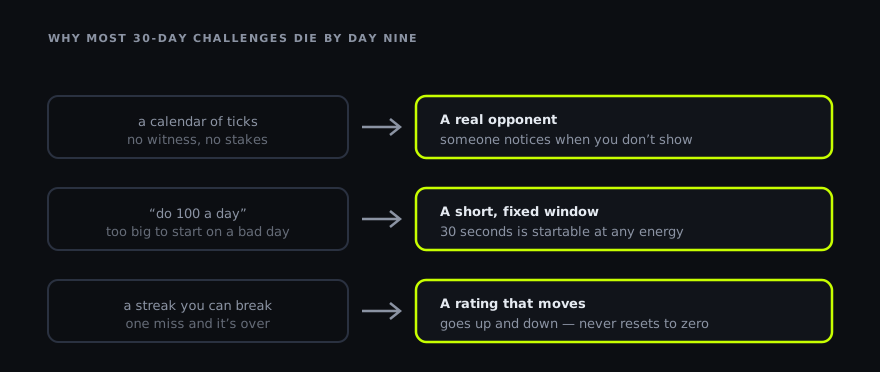
- A real opponent or audience — not just a private tracker
- Immediate feedback, not a weigh-in weeks later
- Low friction to start — no gym drive, no equipment setup
- Short, frequent sessions over long, rare ones
- A visible progress marker, like a rating that goes up or down
Day nine is not a coincidence
Ask anyone who has run a 30-day challenge and they will tell you roughly the same story: the first week is easy, and then somewhere around the second weekend it stops. The reason is that the first week is not being carried by the challenge at all. It is being carried by novelty, and novelty has a short and fairly predictable half-life.
While the novelty lasts, the challenge costs you nothing to maintain, so you never find out whether the design works. The first genuinely bad day — a late night, an argument, an illness, a day that simply got away from you — is the first real test, and it usually arrives in the second week. A design that only works on good days fails on that day, and it fails permanently, because of the next problem.
The streak is the trap
Streaks are the most common motivational device in fitness apps and the most quietly destructive. A streak works beautifully right up until it breaks, and then it inverts: the thing that was pulling you forward becomes a reason to stop. You were on day eleven, you missed one, and now you are on day zero. The eleven days you actually did are gone from the only counter that was tracking them.
That is an unusually cruel piece of arithmetic for something meant to encourage you. It punishes one missed day with the destruction of every good day before it, which is the opposite of how progress actually accumulates in a body. Your muscles do not reset on day zero. Only the counter does.
The fix is to measure something that can go down without going to zero. A rating that drops a few points when you lose and climbs when you win survives a bad week intact. You come back at 1,040 instead of 1,070, which stings appropriately and then gets fixed the following day. Nothing has been erased, so there is nothing to feel is beyond recovering.
Make the bad-day version smaller than the good-day version
Most challenges are calibrated to the day you designed them, which is by definition a day you were feeling good about fitness. Then they are asked to run on days you are not. A hundred push-ups is a perfectly reasonable target invented on a Sunday afternoon and a completely unreasonable one at eleven at night on a Wednesday.
The move that saves more challenges than any other is defining, in advance, the smallest version that still counts. Not as a failure state — as a legitimate outcome you decided on while you were thinking clearly. If the minimum is one 30-second effort, then a terrible day still ends with the streak of showing up intact, and showing up is the habit you were actually trying to build. The volume can come back tomorrow.
Feedback has to arrive while you still care
A challenge that pays out in four weeks is asking you to work now for a reward you cannot yet see, which is the exact structure your brain is worst at sustaining. Weight is a particularly bad progress marker for this reason: it moves slowly, it moves for reasons unrelated to training, and it can go the wrong way in a week you did everything right.
Reps in a fixed window are a much better marker. They respond within days, they respond only to things you control, and they are impossible to argue with. If you did fourteen push-ups in thirty seconds on Monday and sixteen on Friday, something real changed, and you did not have to take anyone's word for it.
The 30-second version
REPPED compresses the entire challenge model into 30 seconds: camera on, random exercise, a real opponent, an immediate AI-judged score, and an Elo rating that moves the instant the match ends. It's small enough to do on a lunch break and public enough that skipping it feels worse than doing it.
Picking your own version
If you're building a personal challenge outside REPPED, borrow the same ingredients: shrink the daily commitment, add a real person watching, and make progress visible immediately rather than after the fact. Or skip the setup entirely and see what a public Elo leaderboard does for your consistency.