Workout Motivation That Actually Lasts (Not Just for January)
Motivation is a mood, and moods are unreliable by nature — that's not a character flaw, it's just what motivation is. Anyone whose fitness plan depends entirely on feeling motivated is building on a foundation that's guaranteed to crack eventually. The people who train for years, not weeks, have almost always replaced 'motivation' with something more durable: systems, identity, and social accountability.
Systems beat willpower
A system removes decisions. If 'work out' requires deciding when, where, what, and whether you feel like it, you've built four separate opportunities to quit before you've done a single rep. Shrinking the decision to 'open the app, 30 seconds, go' removes three of those four opportunities entirely.
Identity beats goals
'I'm trying to work out more' is a goal, and goals get abandoned when they're inconvenient. 'I'm someone who trains' is an identity, and identities get defended even when it's inconvenient. Competitive formats accelerate this shift faster than solo tracking does — climbing a rank or holding a streak becomes part of how you see yourself, not just a box you're trying to check.
Social accountability beats private tracking
A private streak counter is easy to quietly reset and forget. A public leaderboard, a rating that visibly drops when you lose, or a friend who knows you're 'in a season' right now — these create a small cost to quitting that a private app never can. That small cost is often the entire difference between a habit that survives a bad week and one that doesn't.
Motivation is not a resource you can budget
The common mental model is that motivation is a tank that starts full in January and drains over the year, and that disciplined people simply have larger tanks. That model produces bad decisions, because it suggests the fix is to want it more.
A better model is that motivation is weather. It varies for reasons largely outside your control — sleep, stress, whether anything good happened that day — and it is not particularly responsive to being lectured. You would not plan a journey that only works in sunshine and then blame yourself for the rain. You would take a coat.
The coat, in training, is a plan that produces an acceptable outcome on a day you feel like doing nothing. Not an inspiring outcome. An acceptable one. People who train for years are not people who feel like it more often; they are people whose bad-day version is small enough to survive.
The two-minute rule is really a decision rule
The advice to make a habit small enough to do in two minutes is usually explained as a trick for building momentum — you start, and then you carry on. That is sometimes true and is not the main mechanism.
The main mechanism is that a small enough commitment stops being a decision. Deciding whether to do a 45-minute session is a genuine deliberation with real costs on either side, and you will lose that deliberation regularly. Deciding whether to do thirty seconds is not a deliberation at all, because the case against it is embarrassing to make out loud.
This is why shrinking the commitment works even on days when you do only the minimum and stop. The value was never in the volume of that particular session. It was in not having spent the day negotiating with yourself, and in the fact that the identity survived intact into tomorrow.
How to tell whether it is working
The wrong measure is how you feel about training, because that will keep fluctuating and will keep telling you the plan is failing on exactly the days it is doing its job.
A better measure is your worst week. Anyone can string together a good fortnight. The question that predicts whether you will still be doing this in six months is what happened during the week everything went wrong — did the habit disappear entirely, or did it shrink and survive? A plan that produced two short sessions during a genuinely bad week is working better than one that produced six sessions in a good one and then nothing.
The second measure is how long it takes to restart after a gap. Early on, a missed week ends the whole attempt. Later, a missed week is a missed week, and you pick it up on Monday without ceremony. That change — from collapse to interruption — is the actual thing being built, and it is worth more than any number of consecutive days.
A simple checklist
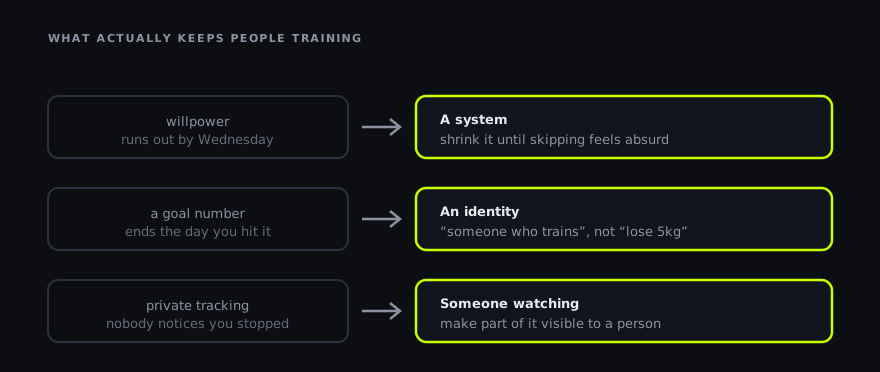
- Shrink the daily commitment until skipping it feels absurd, not virtuous
- Attach your training to an identity, not just a goal number
- Make at least part of your progress visible to someone else
- Expect motivation to fade — build something that doesn't depend on it
Where REPPED fits
A 30-second, camera-on, AI-judged battle hits all three: it's small enough to never skip, competitive enough to build identity around, and public enough (via Elo and the leaderboard) to create real accountability. See how seasonal ranking keeps that accountability fresh every month.