The Perfect Push-Up: A Form Guide That Actually Fixes Your Reps
The push-up is the most-tested movement on REPPED for a reason: it's brutally honest. Bad form doesn't hide in a push-up — it shows up immediately as a half-rep, a sagging hip, or a stall two reps before you wanted to quit. If you've ever finished a set feeling like your arms did all the work and your score still came back low, this is why.
Our pose-estimation model watches four things on every rep: hand and elbow position, chest-to-floor depth, hip alignment, and lockout at the top. Get any one of them wrong consistently and it caps your score no matter how fast you move. Below is the form that satisfies all four — and doubles as good general-purpose push-up technique, on or off camera.
1. Hand placement: slightly wider than shoulder-width
Place your hands just outside your shoulders, fingers spread, middle finger pointing forward. Too narrow (hands under your chest) overloads the triceps and shortens your range of motion in a way that looks like — and often is — a shallow rep. Too wide flares the elbows and stresses the shoulder joint.
2. Elbow angle: 30–45 degrees from your torso
Flaring your elbows straight out to 90 degrees is the single most common push-up fault we see. It feels stable because it recruits the chest more, but it's a fast track to shoulder impingement over time. Keep your elbows tucked to roughly a 30–45 degree angle — imagine your arms forming a slight arrow shape, not a T.
3. Depth: chest to within a fist of the floor
This is the one that costs the most points. A rep that stops halfway down might feel like it 'counts' subjectively, but it isn't the same movement as a full rep, and it isn't scored the same. Depth is judged relative to your own shoulder-to-elbow proportions, not a fixed number — so there's no cheating it with a slightly different camera angle. Go down until your chest is a fist-width from the ground, every rep.
4. Hips: a straight line, not a sagging line
Fatigue makes the hips drop first. A sagging lower back turns a push-up into a partial plank-push-up hybrid that no longer trains (or scores) the same way. Brace your core like someone's about to prod your stomach, and keep glutes lightly squeezed through the whole set. If your hips are dropping by rep 12, that's a sign to build core endurance, not just chest strength.
5. Lockout: elbows fully extended at the top
Stopping just short of full extension at the top is the second most common way people lose points. It's subtle enough that most lifters don't notice they're doing it. Push all the way through until your elbows are straight — that's what separates a counted rep from a 'flagged' one.
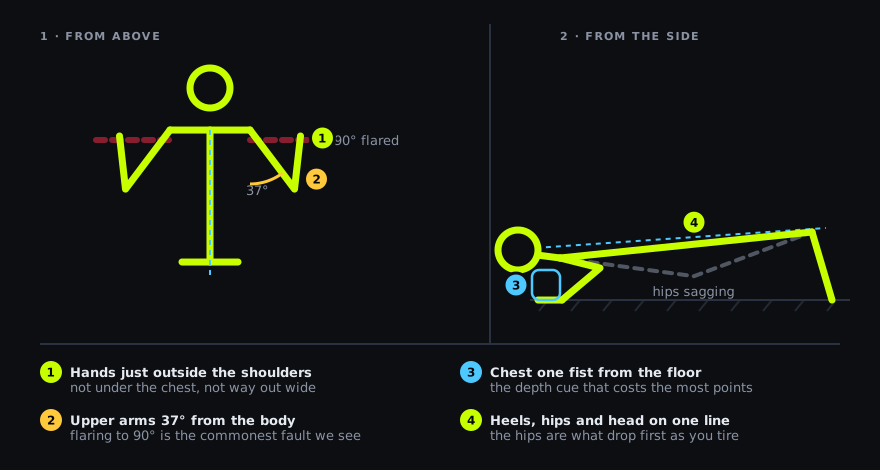
The faults that hide behind each other
Form problems are rarely independent, which is why fixing them one at a time so often fails. The most common chain starts at the hips. When the core gives out and the lower back sags, the shoulders end up further forward relative to the hands than they were, and the easiest way for your body to resolve that is to flare the elbows. You then get told your elbows are wrong, you concentrate on the elbows, and they drift back out three reps later because the actual cause was never the elbows.
A second chain runs the other way. Hands placed too far forward — up near your head rather than under your shoulders — turn every rep into a partial front raise and make lockout feel strangely far away. People respond by cutting the rep short at the top, which reads as a missed lockout when the real fault happened before the set started.
The practical rule: if a cue keeps not sticking, the fault you are correcting is probably downstream of a different one. Check hand position first, then hips, then elbows, then depth. In that order, most of the list fixes itself.
How to film yourself so it is actually useful
Almost nobody can feel their own push-up accurately, and this is not a personal failing — you have no view of your own hip line and your sense of elbow angle is famously unreliable under fatigue. Thirty seconds of video settles arguments that months of concentrating will not.
Put the phone on the floor, roughly two metres away, side-on, propped against something so it sees your whole body from heel to head. From this angle you can judge depth, hip line and lockout, which is three of the five items on the checklist.
Elbow angle is the exception and cannot be judged from the side at all — it is a top-down measurement, which is exactly why so many people flare for years without noticing. Film one set from above or from a corner, once, and you will know which category you are in.
Then watch it at half speed. Full speed hides the two places faults actually live: the moment the hips break at the bottom, and the last few centimetres at the top.
What to do when the form falls apart mid-set
Form does not degrade gradually across a set. It holds, and then it goes, usually within a single repetition, and almost always at the hips first.
When that happens the useful response is not to grind out three more bad reps. It is to stop, or to switch to the elevated version for the remainder. Repetitions performed after form has collapsed are not a harder version of the exercise; they are a different and worse exercise, and on a scored system they are worth close to nothing anyway since half reps count half.
This is also the single best argument for the fixed-window format. A thirty-second cap means the set ends before most people reach the point where they are just accumulating bad repetitions out of stubbornness, which is where injuries and bad motor patterns both come from.
Put it together before your next battle
Slightly-wide hands, tucked elbows, full depth, straight hips, full lockout. That's the whole checklist. Most people can fix two or three of these in a single practice session just by slowing down and filming themselves — which, conveniently, is exactly what happens every time you step into a REPPED battle.
Want to understand exactly how the scoring works under the hood? Read our breakdown of how the AI judges every rep, or jump straight into a live battle and put the form to the test.